Examines how governance, transparency, clinical oversight, and outcome measurement help healthcare organizations scale continuous care programs safely and confidently.
As healthcare organizations expand digital health, remote monitoring, virtual care, and continuous care programs, one theme is becoming increasingly clear: trust determines scale.
Technology may enable new models of care, but trust determines whether those models are adopted, sustained, and expanded.
Patients must trust that continuous care programs will support them without compromising privacy or overwhelming them with unnecessary interactions.
Providers must trust that the information surfaced by digital workflows is clinically meaningful, timely, and actionable.
Care teams must trust that new tools will reduce burden rather than add another layer of complexity. Executives must trust that programs can scale safely, comply with regulatory expectations, and deliver measurable value.
Without trust, continuous care programs remain pilots. With trust, they become part of the operating model.
Continuous care changes the way healthcare is delivered.
Instead of relying only on scheduled appointments, organizations maintain ongoing visibility into patient health status, engagement, risk, and care needs. This creates significant potential for earlier intervention, improved care coordination, and better outcomes.
But it also introduces new questions.
They are trust questions. Continuous care programs need operating discipline that patients, providers, care teams, and executives can believe in.
Patients need confidence that their information is used responsibly, their concerns are reviewed appropriately, and digital interactions improve rather than replace their care experience.
Providers need confidence that continuous care workflows support clinical practice, preserve safety, and provide relevant, prioritized, actionable information.
Care teams need operational clarity around which patients require attention, what actions are expected, when escalation is required, and who owns follow-up.
Patients are increasingly asked to participate in care beyond traditional visits. They may share symptoms, device readings, medication adherence information, lifestyle data, or responses to digital check-ins.
For patients to engage meaningfully, they must believe that:
Patient trust is especially important in chronic care, maternal care, behavioral health, post-acute care, and other settings where continuity and relationship-based care matter.
Providers need confidence that continuous care workflows will support clinical practice rather than disrupt it.
A major concern among clinicians is that digital programs can create more work through excessive alerts, fragmented data, duplicate documentation, and unclear escalation pathways.
For providers to trust continuous care programs, they need:
Care teams are often responsible for the day-to-day operation of continuous care programs.
Nurses, care coordinators, case managers, health coaches, and operations teams may manage patient outreach, review risk signals, coordinate escalations, and support follow-up activities.
For these teams, trust depends on operational clarity.
If workflows are unclear, continuous care programs can increase burden and create operational risk. If workflows are well-designed, they can improve efficiency, reduce ambiguity, and help teams focus on patients who need support most.
Trust in continuous care programs is not created by messaging alone. It is built through operating discipline.
Four components are especially important: governance, transparency, clinical oversight, and outcome measurement.
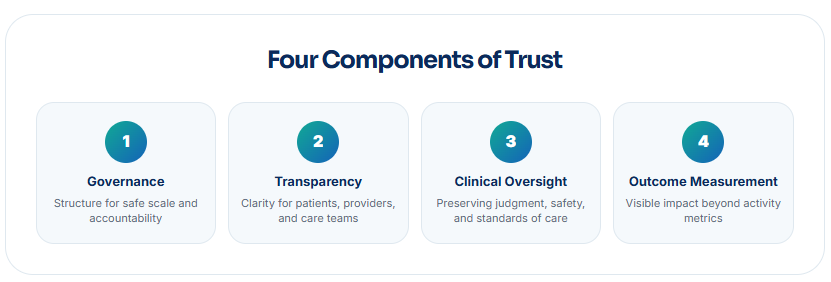
Governance provides the structure required to scale continuous care safely. It defines how decisions are made, who is accountable, how risks are managed, and how programs are evaluated.
Strong governance helps organizations answer key questions:
Governance should not be treated as a barrier to innovation. In mature organizations, governance enables speed by creating confidence.
Transparency is essential for adoption. Patients, providers, and care teams should understand how continuous care programs work.
This includes clarity around:
Transparent programs are easier to trust.
Continuous care programs must preserve clinical judgment. Technology can help identify risk, prioritize attention, and support coordination. But healthcare decisions often require context, judgment, and patient-specific understanding.
Clinical oversight ensures that continuous care programs remain safe, appropriate, and aligned with standards of care.
The goal is not to slow down care. The goal is to ensure that faster care remains clinically responsible.
Trust grows when impact is visible. Continuous care programs should be measured not only by activity but by value.
Traditional digital health metrics such as logins, messages, or device readings provide limited insight. Healthcare leaders increasingly need to understand whether programs are improving care delivery.
Outcome measurement helps organizations distinguish between programs that generate activity and programs that create impact.
Healthcare organizations face a difficult balancing act.
They must innovate quickly enough to respond to rising demand, workforce pressure, and changing patient expectations. At the same time, they must maintain compliance, protect patient safety, and preserve clinical confidence.
Scaling safely requires balancing three forces: innovation, compliance, and operational speed.
Innovation is necessary because traditional models of care are under pressure. Healthcare organizations need new ways to extend care beyond visits, monitor patients longitudinally, and intervene earlier.
However, innovation cannot be disconnected from operational reality. Programs should be designed with scale in mind from the beginning:
Innovation becomes meaningful only when it can be operationalized.
Healthcare organizations operate in highly regulated environments. Privacy, security, consent, data handling, clinical documentation, and patient safety requirements must be considered from the start.
Compliance should not be added after a program is designed. It should be built into the operating model.
When compliance is embedded into workflows, organizations can scale with greater confidence.
Speed matters. Healthcare organizations cannot wait years to modernize care delivery. Patient needs, workforce constraints, and financial pressures require faster execution.
But speed without structure creates risk. The goal is not uncontrolled acceleration. The goal is disciplined speed.
Disciplined speed is possible when organizations have:
In this model, governance and speed are not opposites. Governance enables speed by creating trust.
Trust is often discussed as a compliance or risk topic. In continuous care, trust is also a competitive advantage.
Healthcare organizations that build trusted continuous care models can scale faster because stakeholders are more willing to adopt and expand them.
It turns digital health programs from isolated experiments into sustainable operating models.
As healthcare moves toward continuous care, organizations will increasingly depend on connected workflows, remote monitoring, digital engagement, risk visibility, and coordinated interventions.
These capabilities create enormous potential. But they also require confidence.
The organizations that succeed will not simply deploy more tools. They will build trusted operating models for continuous care.
Continuous care programs must therefore be designed not only for functionality, but for confidence.
Trust requires governance, transparency, clinical oversight, and outcome measurement.
It requires balancing innovation with compliance and operational speed. It requires designing workflows that patients, providers, care teams, and executives can believe in.
In the next phase of digital health, trust will not be a soft concept. It will be a core operating requirement. And for organizations seeking to scale continuous care, it may become one of the most important capabilities of all.
GCare.ai helps healthcare organizations deploy connected workflows, monitoring operations, risk visibility, and clinician-guided care coordination.