Highlights why promising digital health initiatives stall after pilots and how workflow integration, governance, clinical adoption, and measurement help organizations move toward operational scale.
Over the past decade, healthcare organizations have invested billions of dollars in digital transformation initiatives. Remote patient monitoring platforms, virtual care programs, patient engagement solutions, digital therapeutics, clinical decision support tools, connected devices, and data analytics platforms have entered the market at an unprecedented pace.
Yet despite this wave of innovation, many healthcare leaders continue to face a familiar challenge:
Why do so many promising digital health initiatives struggle to scale?
The answer is increasingly becoming clear. The healthcare industry does not suffer from a lack of technology. It suffers from a lack of operationalization.
Across health systems, provider organizations, payers, and digital health companies, the conversation is shifting away from technology adoption and toward operational readiness. The focus is no longer on whether a solution works in a pilot environment. The focus is now on whether it can become part of everyday care delivery.
Sustainable transformation occurs when monitoring, engagement, risk visibility, escalation, and intervention workflows become embedded within everyday care operations.
Healthcare has become exceptionally good at launching pilots. Organizations routinely evaluate innovative technologies through limited deployments, proof-of-concept projects, and targeted use cases. These pilots often generate encouraging results.
Yet many of these initiatives never progress beyond the pilot stage.
The healthcare industry has become increasingly familiar with what many leaders refer to as the “pilot trap” — a cycle in which organizations continuously test innovation without successfully scaling it across populations, service lines, or care settings.
The challenge is rarely the technology itself, but moving from a controlled pilot environment to operational reality.
Several common factors contribute to this gap between innovation and scale.
Programs deployed alongside existing care processes often create duplicate documentation and manual coordination.
Scaling raises questions around execution, escalations, alerts, outcomes, and team consistency.
Pilots often rely on temporary support. Scale requires sustainable operating models.
Without governance, scaling becomes difficult, and risk increases.
Many digital health programs are deployed alongside existing care processes rather than integrated into them. Care teams often find themselves navigating multiple systems, duplicate documentation requirements, disconnected communication channels, and manual coordination activities.
When technology creates additional work rather than reducing it, adoption inevitably suffers.
Successful pilots often benefit from dedicated project teams, executive sponsorship, and focused attention. As programs attempt to scale, questions emerge:
Without clear accountability, programs struggle to move beyond early success.
Many pilots operate with temporary funding, dedicated personnel, or specialized support teams. Scaling requires sustainable operational models.
Healthcare organizations must determine how programs fit within existing staffing structures, workflows, budgets, and care delivery models. Without operational sustainability, even successful pilots remain isolated initiatives.
Healthcare organizations must balance innovation with safety, compliance, quality, and accountability. Organizations need clear processes for:
While technologies evolve rapidly, the factors that enable scale remain remarkably consistent. Healthcare organizations that successfully operationalize digital health initiatives typically focus on four foundational capabilities.
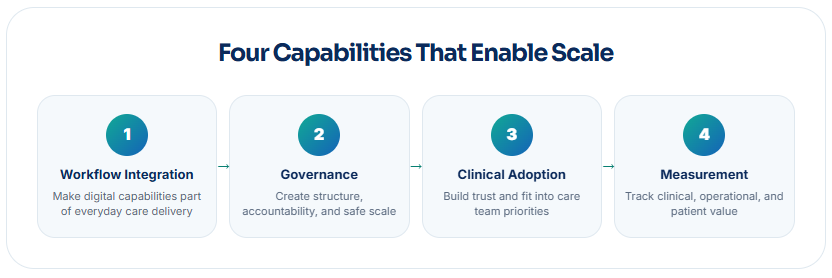
Technology adoption succeeds when workflows improve. It struggles when workflows become more complex. The most successful healthcare organizations focus on integrating new capabilities directly into existing care delivery processes.
Instead of creating separate digital programs, they create connected operational workflows.
Technology becomes effective when it disappears into the workflow.
Governance is often misunderstood as bureaucracy. In reality, governance creates the structure required for sustainable scale.
Organizations that scale successfully understand that governance enables innovation rather than slowing it down.
No digital health initiative can succeed without clinician trust and participation. Clinical teams must understand why the program exists, how it supports patient care, when intervention is required, what actions should be taken, and how outcomes are measured.
Adoption improves when programs align with clinical priorities rather than introducing additional complexity. Successful organizations design workflows around care teams rather than expecting care teams to adapt to technology.
Healthcare leaders increasingly expect measurable business and clinical outcomes. Successful programs define metrics from the outset.
Measurement creates visibility into value and supports long-term investment decisions.
If scaling digital health is fundamentally an operational challenge, what capabilities should organizations prioritize? Several themes consistently emerge among successful deployments.
Standardization reduces variability and improves scalability. Organizations need repeatable approaches for:
Standardized workflows allow programs to expand across populations without requiring entirely new operating models.
Monitoring alone does not improve outcomes. Actions do. Organizations need clearly defined escalation models that determine:
Without escalation pathways, monitoring simply generates information. Operational workflows transform information into action.
Healthcare remains fundamentally human. Technology can support visibility and coordination, but clinical judgment remains essential.
This ensures that technology supports care delivery without replacing professional oversight — in other words, enabling human-in-the-loop workflow orchestration.
Organizations cannot improve what they cannot measure. Hence, it is critical to track outcomes beyond technology usage metrics.
The objective is not simply to deploy technology. The objective is to improve care delivery.
One of the most significant changes occurring across healthcare is a shift in mindset. Digital health initiatives are increasingly being viewed not as technology projects but as operating models.
Technology projects have a beginning and an end. Operating models become part of how organizations deliver care.
Organizations that succeed in digital transformation increasingly focus on building capabilities that support:
These capabilities create the foundation for scalable care delivery.
Healthcare organizations today have access to more technology than ever before. The challenge is no longer identifying innovative solutions. The challenge is integrating those solutions into sustainable, repeatable, and scalable care delivery models.
Organizations that focus solely on technology implementation often remain trapped in an endless cycle of pilots. Organizations that focus on operationalization create lasting transformation.
The future of digital health will not be defined by the number of technologies deployed. It will be defined by the ability to operationalize care at scale.
Technology will definitely enable change, but operations make change sustainable.
GCare.ai helps healthcare organizations deploy connected workflows, monitoring operations, risk visibility, and clinician-guided care coordination.