Explain why monitoring alone is not enough and how risk prioritization, escalation workflows, clinical oversight, and follow-up management convert visibility into coordinated action.
Healthcare organizations have invested heavily in digital health technologies over the last decade.
Remote patient monitoring platforms collect patient data. Patient engagement solutions facilitate communication. Electronic Health Record systems centralize clinical information. Connected devices continuously generate health signals. Virtual care platforms extend access beyond traditional settings.
Yet despite these investments, many healthcare leaders continue to encounter a persistent challenge.
But outcomes are not improving as consistently as expected.
The reason is often not a lack of technology. It is the absence of a coordinated operational layer between monitoring and intervention.
Many healthcare organizations have successfully built visibility into patient health. Far fewer have established the workflows required to consistently transform visibility into action.
The missing layer is care coordination.
Monitoring has become a foundational capability across many healthcare organizations.
Remote patient monitoring programs, chronic disease management initiatives, maternal health programs, post-discharge monitoring services, and virtual care models all rely on continuous observation of patient conditions.
The objective is clear:
However, monitoring by itself does not improve outcomes. Monitoring only creates awareness. What happens after monitoring determines whether outcomes improve.
Without clear workflows for review, prioritization, escalation, intervention, and follow-up, monitoring simply creates more information. Coordinated action is what changes outcomes.
Consider a patient with worsening symptoms captured through a monitoring platform. Several questions immediately emerge:
Many healthcare organizations have successfully implemented technologies that provide visibility into patient conditions.
The challenge begins when those insights need to move through clinical and operational workflows.
In many environments:
But the pathway from detection to intervention remains unclear. This creates what can be described as the visibility-to-action gap.
The larger the gap, the greater the risk that critical signals fail to result in timely interventions. As organizations scale monitoring programs across larger populations, this challenge becomes increasingly significant.
One of the most common operational challenges in digital health is the escalation gap. Healthcare organizations often discover that generating alerts is relatively easy. Managing them effectively is much harder.
As programs expand, care teams are exposed to increasing notification volumes, making prioritization difficult.
Teams spend time reviewing patient data, assessing severity, prioritizing follow-up, and routing cases.
Without structured escalation workflows, clinical review, outreach, referrals, and follow-up can be delayed.
The challenge is not generating more alerts. It is creating meaningful prioritization that supports timely action.
As monitoring programs expand, care teams are often exposed to increasing volumes of notifications. Not all alerts are clinically meaningful. Not all require immediate action.
When every signal appears urgent, clinicians struggle to determine which patients truly require attention. Over time, excessive notifications can contribute to alert fatigue, reducing responsiveness and increasing the risk of missed interventions.
Many organizations continue to rely on manual workflows for evaluating and prioritizing patient concerns. Care coordinators, nurses, or clinical teams often spend considerable time:
While manual review remains important, highly manual processes become difficult to sustain as programs scale.
When monitoring insights are not connected to structured escalation workflows, delays can occur. These delays may include delayed clinical review, delayed patient outreach, delayed care plan adjustments, delayed referrals, and delayed follow-up activities.
In many cases, the difference between successful intervention and adverse outcomes is not detection. It is response time.
The organizations demonstrating the greatest success in continuous care programs are focusing on operational coordination as a core capability.
Rather than treating monitoring as the endpoint, they view monitoring as the starting point of a coordinated care process.
Not every patient requires the same level of attention. Effective care coordination begins by creating visibility into which patients require intervention first.
The goal is not to generate more alerts. The goal is to create clearer visibility into where action is needed most.
Once risk is identified, organizations need clearly defined pathways for action. Escalation workflows help determine what constitutes a significant event, who should be notified, what actions should occur, how quickly intervention is required, and how accountability is maintained.
Monitoring without escalation creates information. Escalation workflows create action.
Technology can support visibility and coordination. Clinical judgment remains essential. Successful continuous care programs establish clear mechanisms for clinician review and decision-making.
Continuous care works best when technology supports clinicians rather than attempting to replace them.
Intervention is not the end of the care journey. Organizations also need mechanisms to ensure patients remain engaged after action is taken.
Without follow-up, interventions often lose effectiveness over time. Continuous care requires continuity beyond the initial response.
As healthcare increasingly moves beyond episodic encounters, organizations are recognizing that continuous care is not primarily a technology challenge. It is an operational challenge.
Monitoring systems, devices, EHRs, and engagement platforms help identify patient signals and emerging risks.
Operational workflows determine who acts, when action occurs, and how follow-up is managed.
Digital capabilities can surface trends, patterns, and concerns that require attention.
Care coordination converts information into escalation, intervention, and continuity.
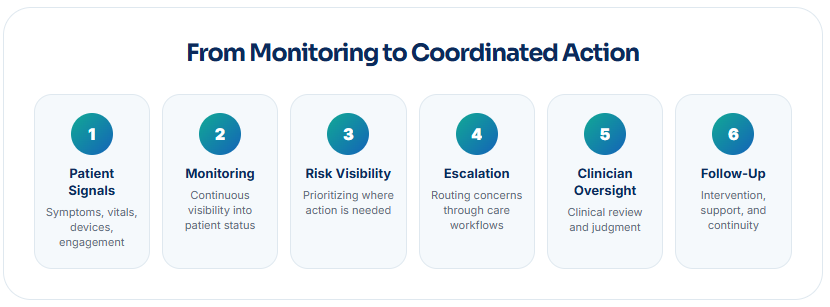
The organizations achieving meaningful results from digital health initiatives are building operational models that connect patient signals, monitoring, risk visibility, escalation coordination, clinician oversight, and intervention and follow-up.
Each stage plays an essential role. When one stage is missing, the effectiveness of the entire care model can be diminished.
Healthcare organizations are rapidly expanding investments in monitoring technologies, connected devices, virtual care services, and patient engagement platforms.
These investments are creating unprecedented visibility into patient health. However, visibility alone does not improve outcomes.
Outcomes improve when organizations establish the operational processes required to convert insights into action.
The next phase of digital health transformation will not be defined by better monitoring technologies alone. It will be defined by stronger coordination between monitoring and intervention.
Organizations that successfully build this capability will be better positioned to:
Monitoring is important. Data is valuable. Visibility is essential.
But better outcomes depend on what happens after monitoring.
The healthcare organizations that succeed in continuous care will be those that build effective coordination between monitoring, escalation, clinician oversight, intervention, and follow-up.
Because in healthcare, the greatest value is not created when risk is identified. It is created when action is taken.
GCare.ai helps healthcare organizations deploy connected workflows, monitoring operations, risk visibility, and clinician-guided care coordination.