Healthcare is moving beyond episodic encounters toward continuous care relationships — where visibility, engagement, risk identification, and timely intervention happen between visits.
For decades, healthcare delivery has largely revolved around episodic interactions. Patients visit a clinic, receive treatment, and return only when another health event occurs. While this model has served healthcare systems for generations, it is increasingly proving inadequate in a world where chronic conditions, workforce shortages, and rising patient expectations demand a different approach.
Healthcare leaders today are facing a fundamental reality: most health outcomes are determined between visits, not during them.
A patient with diabetes may spend less than two hours annually interacting with healthcare professionals. A heart failure patient may be clinically stable during an appointment but deteriorate days later. A high-risk pregnancy may require ongoing observation and intervention long before complications become visible during a scheduled visit.
The challenge is no longer delivering care during encounters. The challenge is maintaining visibility, engagement, and intervention capability between encounters.
This shift is driving healthcare organizations toward a new operational model: continuous care.
Several converging forces are accelerating the need for continuous care delivery.
Chronic diseases now account for the majority of healthcare utilization and spending worldwide. Conditions such as diabetes, hypertension, cardiovascular disease, COPD, and obesity require ongoing management rather than episodic treatment.
The traditional model often identifies deterioration after symptoms become severe enough to trigger a visit, hospitalization, or emergency intervention. Healthcare organizations are increasingly recognizing that better outcomes require earlier visibility into patient health trends.
The question is no longer how to treat chronic disease. The question is how to continuously manage risk before it becomes acute.
Healthcare systems are experiencing unprecedented demand from aging populations. Older adults often require:
At the same time, healthcare organizations face resource constraints that make traditional high-touch care models difficult to scale.
Continuous care models provide a mechanism to extend clinical oversight without requiring additional in-person encounters for every patient interaction.
Continuous care is often misunderstood as simply deploying remote monitoring devices or patient engagement applications.
In reality, continuous care is an operating model. It enables healthcare organizations to maintain visibility into patient health status, identify risk early, coordinate interventions, and support patients between traditional care encounters.
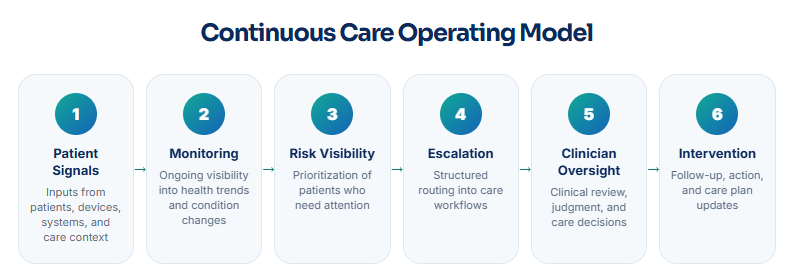
Each stage plays a critical role in transforming data into meaningful care actions.
Continuous care begins with capturing relevant patient signals. These may include:
The objective is not collecting more data. The objective is creating meaningful visibility into patient health status between visits.
Monitoring provides ongoing observation of patient conditions and health trends. Rather than relying solely on scheduled appointments, organizations can maintain awareness of:
This enables care teams to move from reactive care toward proactive management.
Not every signal requires intervention. Healthcare organizations need mechanisms to prioritize attention toward patients who require action.
Risk visibility helps organizations:
The goal is to create clarity, not alerts. Visibility allows organizations to understand where intervention can create the greatest impact.
One of the biggest gaps in many care programs occurs between identifying risk and initiating action. Escalation coordination ensures that identified concerns move through structured workflows that trigger appropriate responses.
This may involve:
Effective escalation workflows reduce delays and help organizations respond consistently and efficiently.
Continuous care is not about replacing clinicians. It is about enabling clinicians to focus on patients who need their expertise most.
By improving visibility and prioritization, care teams can spend less time searching for information and more time making informed decisions.
Clinician oversight remains essential for:
Technology can support visibility. Clinical judgment remains central to care delivery.
The ultimate objective of continuous care is action. Interventions may include patient outreach, medication adjustments, care plan modifications, telehealth consultations, additional assessments, and referral coordination.
The process does not end with intervention. Follow-up ensures patients remain engaged, supported, and progressing toward desired outcomes.
Across healthcare organizations, several strategic priorities are consistently emerging.
Healthcare leaders increasingly recognize that earlier action improves outcomes while reducing costs.
Engaged patients are more likely to follow care plans, adhere to therapies, participate in self-management, and maintain healthier behaviors.
Healthcare organizations are seeking ways to reduce administrative burden, improve care team productivity, optimize resource allocation, and scale programs.
Success is being evaluated through patient outcomes, care quality metrics, intervention effectiveness, operational efficiency, and patient experience improvements.
The focus has shifted from technology adoption to operational impact.
Healthcare is entering a new era. The organizations that succeed will not simply digitize existing processes. They will redesign care delivery around continuous visibility, engagement, coordination, and intervention.
The future of healthcare is not defined by more visits. It is defined by stronger relationships between visits.
Continuous care is no longer a pilot program, a digital initiative, or an emerging trend. It is becoming a foundational capability for healthcare organizations seeking to improve outcomes, enhance patient experiences, and scale care delivery in an increasingly complex environment.
The question is no longer whether continuous care will become part of healthcare delivery. The question is how quickly organizations can operationalize it.
GCare.ai helps healthcare organizations deploy connected workflows, monitoring operations, risk visibility, and clinician-guided care coordination.