Discusses the shift from AI-first thinking to work-first transformation, showing how AI creates value when embedded into care delivery, operations, and measurable outcomes.
Over the past few years, artificial intelligence has become one of the most discussed topics across all industries and in healthcare.
Organizations have explored predictive analytics, clinical decision support, ambient documentation, virtual assistants, patient engagement tools, and numerous other AI-enabled capabilities. Technology vendors have demonstrated increasingly sophisticated models, impressive accuracy metrics, and innovative use cases.
Yet despite significant investment and enthusiasm, healthcare leaders are becoming more pragmatic in how they evaluate AI initiatives.
The questions being asked today are fundamentally different from those being asked just a few years ago.
The industry is gradually shifting from an AI-first mindset to a workflow-first mindset.
This evolution represents an important milestone in healthcare's digital transformation journey.
The first wave of AI adoption in healthcare was largely driven by possibility. Organizations were eager to understand what artificial intelligence could do.
Technology demonstrations focused on:
The conversation often centered on the technology itself.
Proof-of-concept projects showcased how AI could:
Many of these innovations generated significant interest and demonstrated genuine potential. However, a recurring challenge emerged: demonstrating value in a pilot environment did not always translate into measurable impact at scale.
Organizations discovered that sophisticated technology alone was insufficient. Success depended on how the technology fits into everyday care delivery.
As healthcare organizations gain more experience with AI, expectations are becoming increasingly operational. Technology remains important, but leaders are now evaluating AI through a different lens.
One of the first questions leaders ask today is: what changes for the care team?
Healthcare environments are already complex. Clinicians, nurses, care coordinators, and operational staff manage numerous responsibilities while navigating significant workload pressures.
If an AI solution simply generates additional information without improving workflows, its value becomes limited.
Healthcare leaders increasingly expect technology to:
The focus is shifting from technology capabilities to workflow improvement.
Healthcare organizations are also becoming more deliberate about understanding who benefits from AI adoption. The answer should be clear.
When benefits are clearly aligned with stakeholders, adoption becomes significantly more sustainable.
Perhaps the most important question healthcare leaders now ask is: how do we know it is working?
Early AI discussions often focused on model performance. Today, organizations increasingly focus on operational and clinical outcomes.
The emphasis is moving from technical performance to measurable business and care delivery impact.
The most successful healthcare organizations are no longer implementing AI as a standalone capability. They are embedding it within workflows.
Technology creates possibilities. Workflows create outcomes.
One of the fastest-growing areas of AI adoption in healthcare is ambient documentation. The primary value is not speech recognition. The primary value is reducing administrative burden.
By automatically generating clinical notes and documentation, clinicians can spend less time typing and more time engaging with patients. The technology succeeds because it improves an existing workflow.
Healthcare systems often struggle with fragmented patient journeys. Patients may encounter challenges related to scheduling, follow-up, referrals, education, and ongoing engagement.
AI-enabled navigation capabilities can help organizations:
Again, the value is not the technology itself. The value is creating a smoother care experience.
Healthcare organizations increasingly collect large volumes of patient information through monitoring systems, engagement platforms, and connected devices. The challenge is determining which patients require attention first.
AI can assist by helping organizations:
However, the greatest value emerges when prioritization is connected to operational workflows that enable timely review and intervention.
Risk visibility alone does not improve outcomes. Coordinated action does.
Clinical decision support represents another area where healthcare leaders are focusing on workflow integration.
Decision support tools can provide relevant information, recommendations, or contextual guidance at the point of care. When implemented effectively, these capabilities can help:
Successful implementations support clinician judgment rather than attempting to replace it. The objective is to make decisions easier, not automate decision-making entirely.
The next phase of AI adoption in healthcare is likely to be less visible. And that may be a positive sign.
Historically, new technologies often attract attention because they are novel. As they mature, they become infrastructure. Healthcare leaders are increasingly viewing AI in the same way.
The future is unlikely to be defined by standalone AI applications. Instead, AI will increasingly function as an enabling layer embedded within broader operational processes.
It will help organizations:
In many cases, users may interact with improved workflows without directly noticing the technology behind them.
The conversation will gradually shift from: "What AI are we using?" to "How efficiently are we delivering care?"
That shift reflects the maturation of the healthcare AI market.
As healthcare organizations increasingly move toward continuous care models, workflow transformation becomes even more important.
Continuous care requires organizations to coordinate each stage of the care journey, from patient signals through intervention and follow-up.
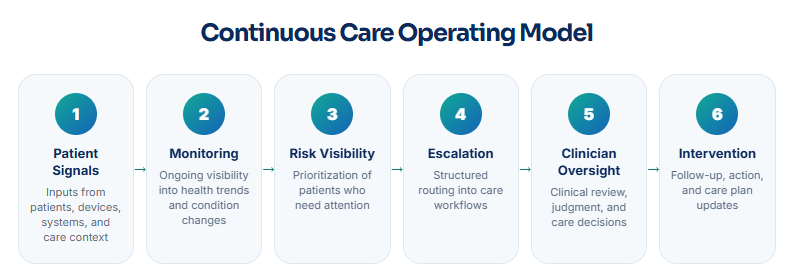
Each stage depends on efficient workflows. Technology can support visibility and prioritization. But sustainable impact requires operational coordination.
Organizations that focus solely on technology implementation may struggle to achieve scale. Organizations that focus on workflow transformation are better positioned to operationalize continuous care across larger populations and care settings.
The healthcare industry's relationship with AI is evolving. The initial focus on capabilities, models, and demonstrations is giving way to a more practical conversation centered on operations, outcomes, and workflow improvement.
Healthcare organizations do not create value simply by deploying technology. They create value when technology helps care teams work more effectively, enables earlier interventions, improves patient experiences, and supports better outcomes.
The future of AI in healthcare will not be defined by increasingly sophisticated algorithms alone. It will be defined by the ability to improve how care is delivered.
Because ultimately, healthcare transformation is not primarily a technology challenge. It is a workflow challenge.
GCare.ai helps healthcare organizations deploy connected workflows, monitoring operations, risk visibility, and clinician-guided care coordination.