Hospitals do not primarily lack data. They lack a reliable operating layer that can combine fragmented signals, identify an intervention window, assign accountable work and prove whether the intervention changed the outcome.
Hospitals do not primarily lack data. They lack a reliable operating layer that can combine fragmented signals, identify an intervention window, assign accountable work and prove whether the intervention changed the outcome.
This enhanced edition integrates current U.S. hospital-market evidence with the proposed GCare.ai architecture. The evidence supports a focused entry through pre-bill denial prevention, followed by modular expansion into patient flow, workforce and executive operations. The architecture and expected benefits remain hypotheses until validated through hospital-specific discovery and a measured pilot.
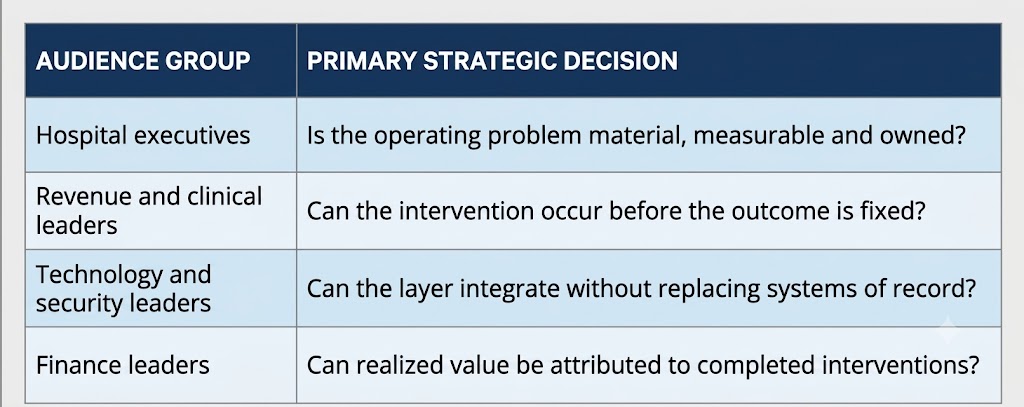
Hospitals have invested heavily in systems that record care, claims, staffing and financial transactions. Yet a preventable denial, delayed discharge or staffing gap often emerges across several systems and teams before one person can act on the full picture. The proposed Enterprise Care Operations Intelligence Platform addresses that coordination problem. It brings events, policies, predictions, evidence and accountable work into one operational layer above existing systems of record.
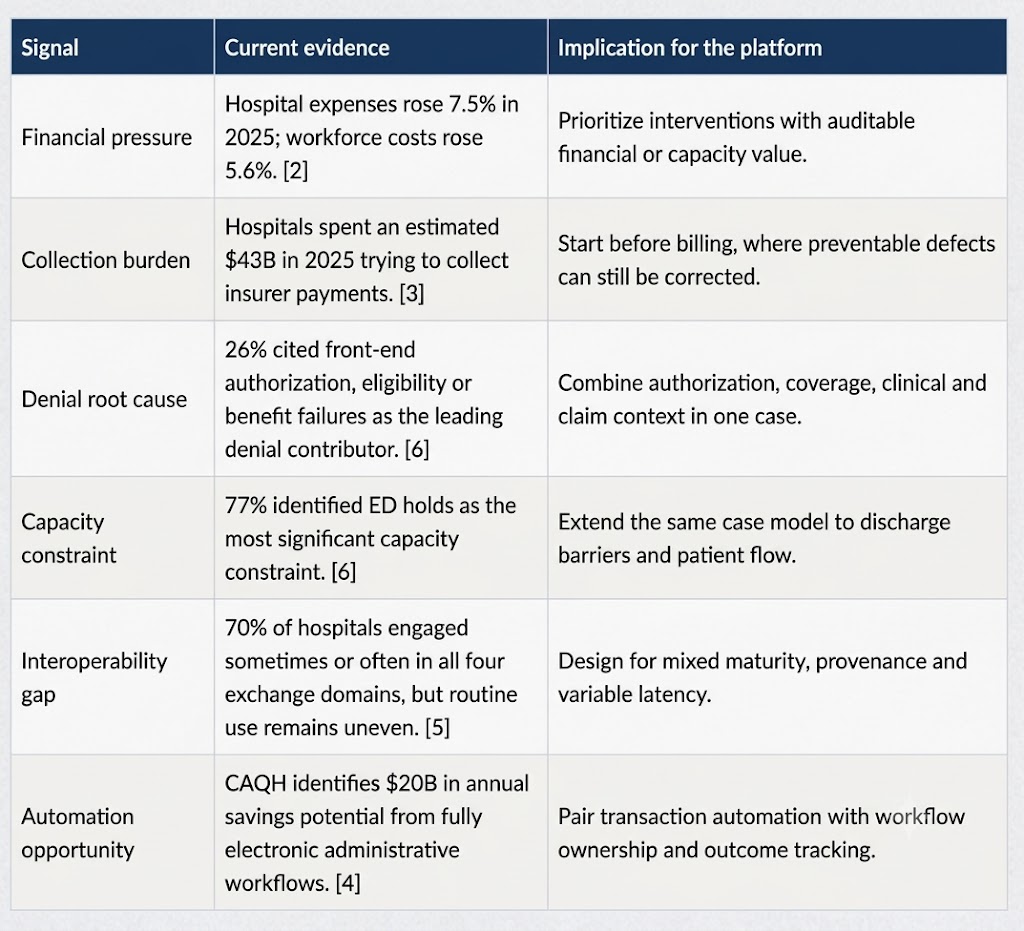
The market evidence strengthens the urgency. AHA reports that U.S. hospital expenses grew 7.5% in 2025, more than twice the growth in hospital prices, while workforce costs rose 5.6% and represented about 60% of total expense. Hospitals also spent an estimated $43 billion trying to collect payment from insurers for care already delivered. [2, 3] At the same time, Kaufman Hall found that front-end breakdowns such as authorization, eligibility and benefit verification were the most frequently cited hospital denial challenge, and 77% of surveyed health-system respondents identified emergency-department holds as their most significant capacity constraint. [6]
The addressable setting is large but heterogeneous. AHA counts 5,121 U.S. community hospitals, including 1,797 rural community hospitals and 1,554 community hospitals outside a health system. [1] This does not establish a serviceable market by itself; it shows why a modular, integration-conscious offer matters. Community and regional hospitals often need measurable improvement without a multi-year replacement program.
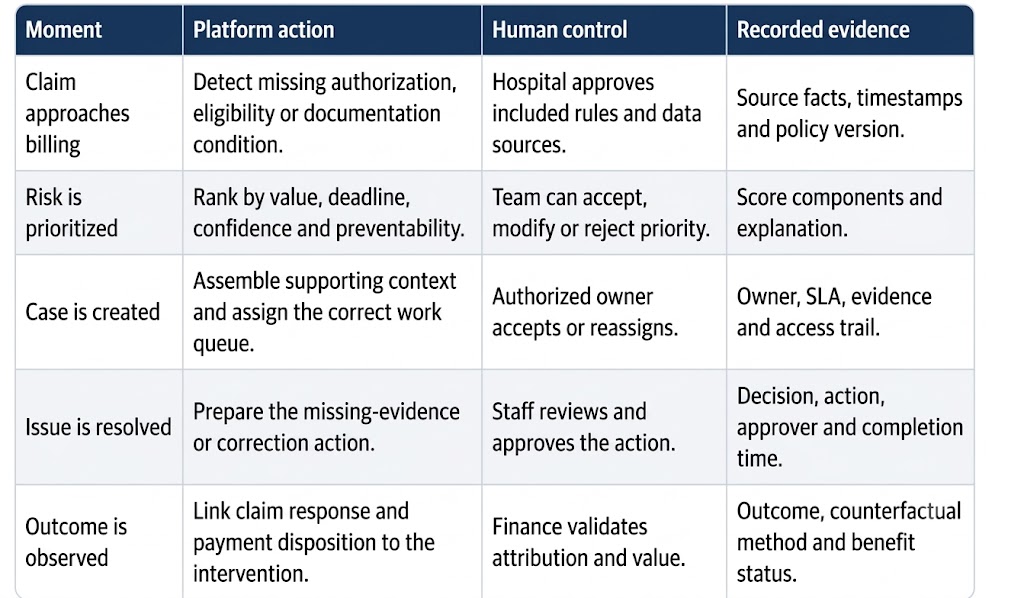
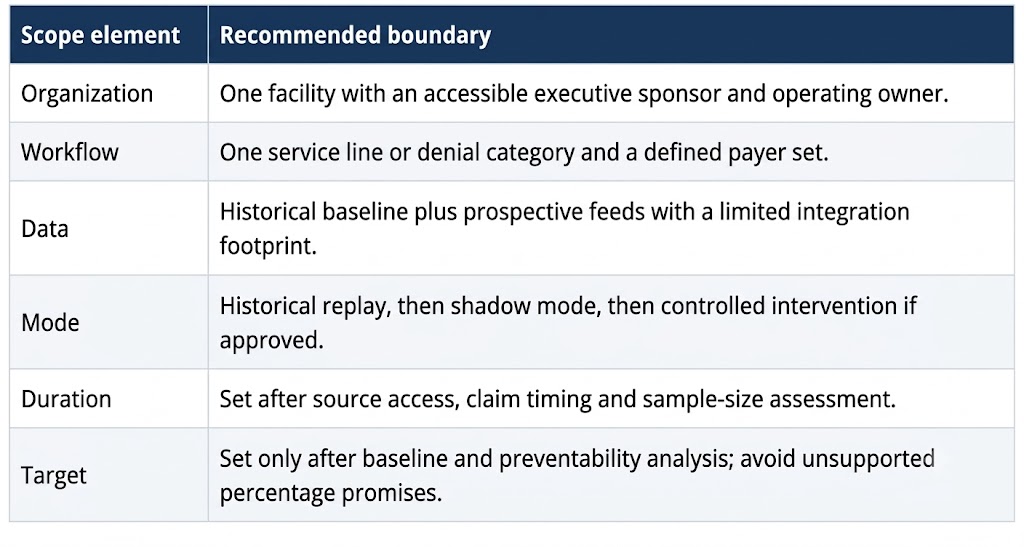
For an initial U.S. engagement, pre-bill denial prevention remains the recommended commercial wedge. The platform would identify a claim at risk before submission, show the reason and supporting evidence, route a correction to an authorized owner and measure whether the intervention changed the disposition. A bounded pilot should use one facility, one service line or denial category, a defined payer set, historical baseline and prospective shadow mode. Improvement targets should be set only after baseline assessment.
The strategic test is not whether GCare.ai can generate another score. It is whether the hospital can reliably move from signal to evidence, from evidence to owned action, and from action to a finance-validated outcome.
1. The operational Gap
The same pattern appears beyond revenue cycle. Discharge planning depends on consults, results, payer approvals, post-acute capacity and transport. Workforce decisions depend on census, anticipated discharges, acuity proxies, credentials and scheduling. Reporting explains what happened; operating teams also need a way to identify what may happen next, assign a response and confirm the result.
Interoperability is necessary but not sufficient. ONC reported that 70% of hospitals in 2023 sometimes or often engaged in all four measured domains of interoperability: finding, sending, receiving and integrating information. Yet the same research found substantial variation in how consistently information was exchanged with external providers and used at the point of care. [5] Data exchange can make a signal available; it does not automatically create ownership, urgency, a service-level deadline or evidence of closure.
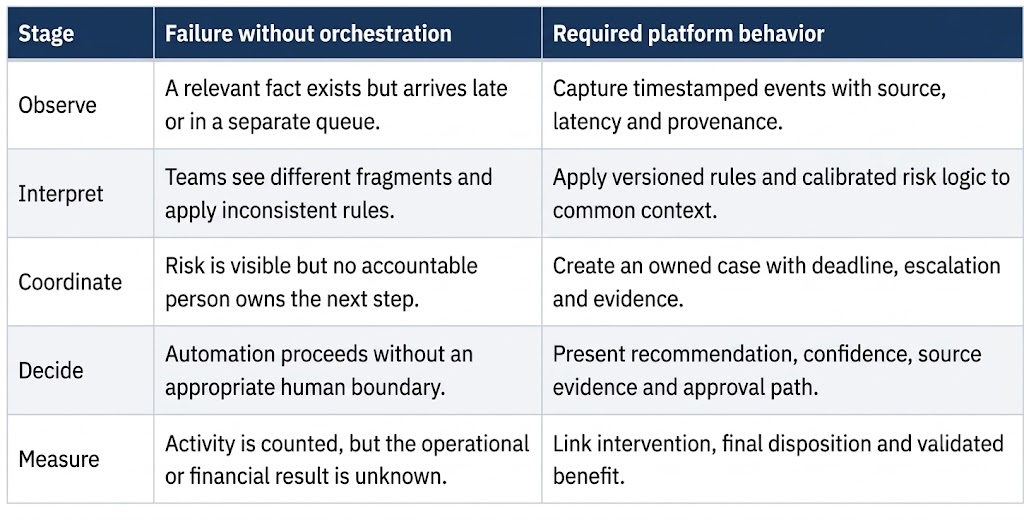
A case is a risk or opportunity with source evidence, an accountable owner, an intervention deadline, a decision record and a measured result. This is the practical bridge between a prediction and a process change. The platform should distinguish an observed fact from a derived risk, a recommendation and a human decision. Every material recommendation needs an explanation, supporting evidence and a clear path for correction or rejection.
2. Market Forces Shaping Demand
The case for an operations-intelligence layer is supported by converging economic, regulatory and operating pressures. None proves demand for a specific product. Together they define the conditions under which a focused, measurable offer can earn executive attention.
AHA reported that hospital expenses increased 7.5% in 2025, with supplies up 9.9% and drugs up 13.6%; workforce costs, the largest expense category, rose 5.6%. [2] In this environment, technology cannot be justified only by activity counts, alerts generated or user logins. It must connect to a defendable financial mechanism: a denial prevented, labor hour avoided, day of avoidable stay reduced, capacity released or cash accelerated.
Revenue-cycle pressure makes prevention more attractive than recovery. AHA cited an estimated $43 billion spent by hospitals in 2025 attempting to collect payment from insurers for care already delivered. [3] A separate AHA market scan, drawing on industry research, reported that nearly 15% of claims submitted to private payers were initially denied and that hospitals spent $19.7 billion in 2022 trying to overturn denied claims. [7] These figures use different populations and methods and should not be combined. Their common implication is that the cost of rework is material and that earlier intervention deserves evaluation.
The 2024 CAQH Index estimates $440 billion in annual U.S. health-care administrative spending, tracks $90 billion of transaction-related spending, and identifies a further $20 billion annual savings opportunity from moving manual or partially electronic workflows to fully electronic processes. It also estimates that existing automation avoids $222 billion in annual administrative costs. [4] These are industry-wide estimates, not savings available to one hospital or to GCare.ai. They demonstrate that standardized exchange matters, while the remaining gap often lies in exceptions, evidence assembly, ownership and follow-through.
CMS-0057-F adds a regulatory tailwind. Impacted payers must meet operational requirements beginning in 2026 and generally implement FHIR-based prior-authorization APIs beginning in 2027. The APIs must expose documentation requirements and support request and response exchange. [8] This can improve access to payer information, but hospitals will still need to translate payer responses, clinical documentation and local work into an accountable resolution process.
Kaufman Hall found that 77% of respondents identified ED holds as the most significant capacity constraint. [6] AHRQ characterizes ED boarding as a hospital- and health-system-level problem and warns that crowding can compromise timeliness, safety, efficiency, patient-centeredness and equity. [9] The implication is not that software alone solves flow. It is that barriers must be detected early, assigned across departments and escalated before they consume scarce capacity.
Workforce pressure magnifies the cost of fragmented work. When labor represents about 60% of hospital expense, every avoidable search, handoff, duplicate review and manual escalation consumes a scarce resource. [2] The right design principle is therefore augmentation: give staff a prioritized case with the relevant evidence and next step, preserve human authority, and remove administrative friction rather than create another queue.
3. U.S. customer segment and buying logic
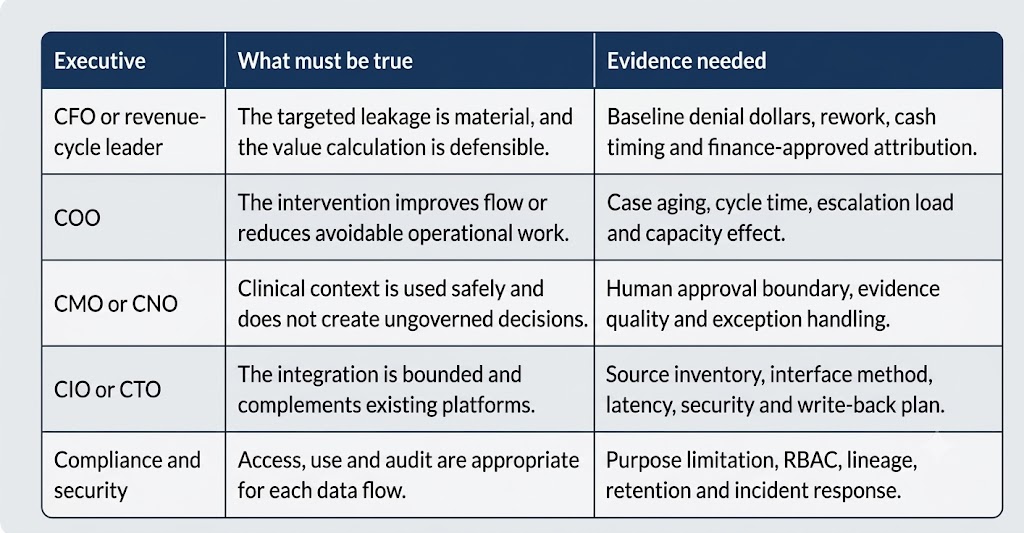
A broad platform story asks the buyer to trust architecture, integration and value across multiple domains at once. A narrow wedge asks the buyer to validate one operating mechanism. Pre-bill denial prevention is suitable because the outcome is financially meaningful, the intervention window can be specified, the human owner is identifiable, and the result can be traced from risk to claim disposition. The shared foundation then becomes an expansion asset rather than an opening abstraction.
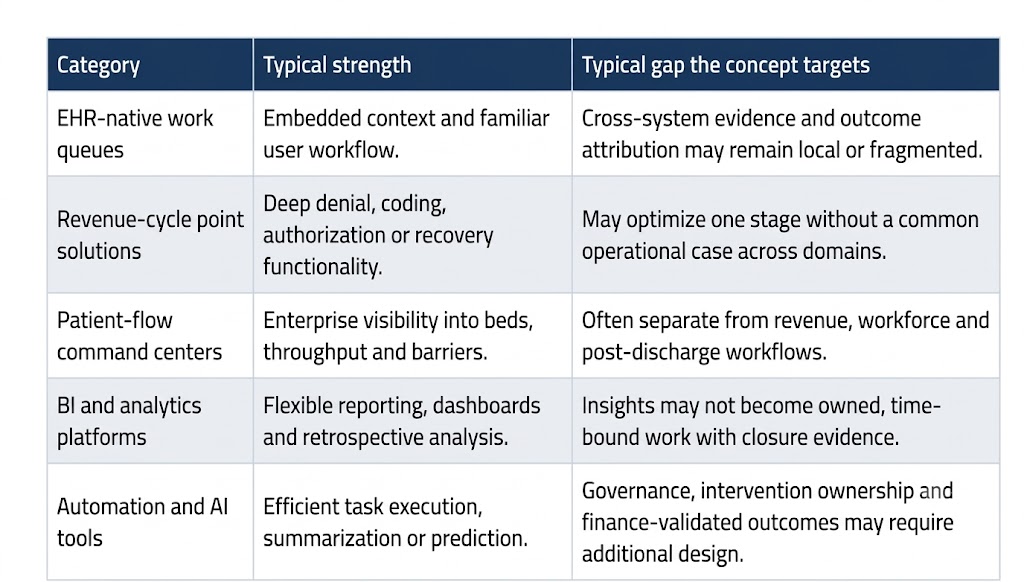
The credible differentiator is therefore not vendor neutrality alone. It is a closed-loop operating model that combines clinical, authorization, claim, operational and financial context; converts each material risk into owned work; supports shadow mode and human approval; and measures the outcome of the intervention.
4. Proposed architecture
The architecture supports both time-sensitive interfaces and scheduled feeds. A batch extract can be appropriate for historical baselines; it may be too late for a pre-bill correction that must occur that day. Discovery should record source, frequency, latency, quality, permitted use and write-back for every critical field. Missingness and stale data should be visible to the user, not silently converted into confidence.
Deterministic rules should govern policy-critical steps. Predictive models may rank cases when historical data is sufficient and performance is monitored. Language models or bounded agents can summarize documents, assemble evidence and draft a proposed action, with source citations and review by an authorized person. The recommendation engine should expose the reason, policy or model version, relevant evidence, uncertainty, intervention deadline and allowed actions.
Cases should support assignment, acceptance, reassignment, service-level timers, escalation, collaboration, approval, closure reason and reopen logic. The platform should link to the system of record rather than duplicate unnecessary transactional functions. Write-back should be used only where technically supported, locally approved and auditable.
The concept proposes an operational knowledge graph to connect dependencies such as encounter, payer, authorization, documentation, task and outcome. Its value should be tested against the first use case. A graph is warranted when relationship traversal materially improves explanation, impact analysis or root-cause learning; it should not be adopted merely as an architectural label.
5. Operational Intelligence Packs
Packs make the platform commercially and operationally modular. Each combines a defined workflow, required data, policy logic, user experience, measures and governance while sharing the underlying foundation. The catalogue is an expansion roadmap, not the scope of a first release.
The platform thesis depends on reuse. A second pack should benefit from existing identity, event ingestion, canonical entities, case services, role management, audit, monitoring and benefit measurement. Local workflow rules, contract terms and thresholds will still vary. The economic question is therefore not whether every new use case is configuration-only, but whether the marginal integration and governance effort falls as validated assets accumulate.
6. Initial wedge Pre bill denial prevention
 Pilot measures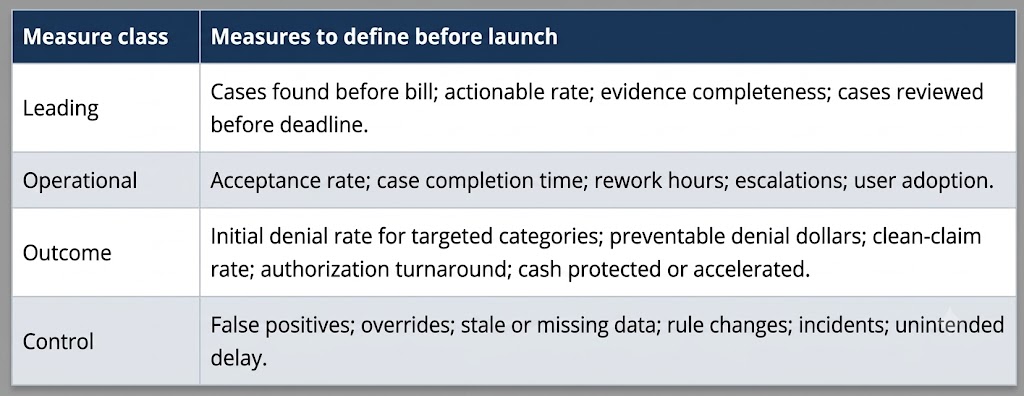
7. Finance ready value measurement
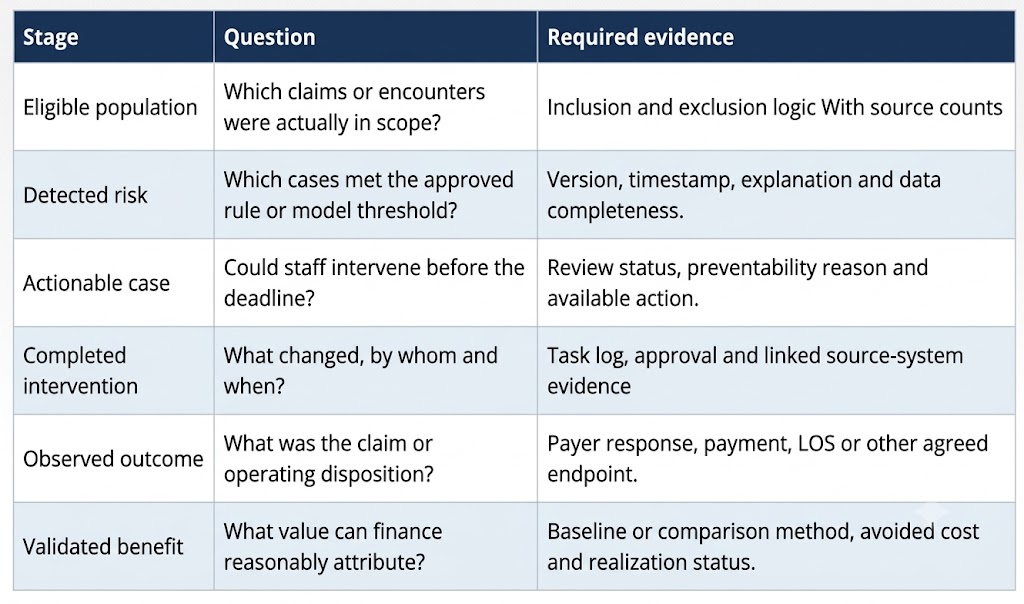
A credible pilot follows value through the full intervention funnel: eligible population, risks detected, cases reviewed, recommendations accepted, work completed, outcome observed and benefit realized. Gross opportunity is not the same as actionable opportunity. A corrected claim is not the same as collected cash. Capacity released is not automatically monetized.
Prevented denial value = sum of allowed amount for targeted claims that were corrected before billing, adjusted by an agreed counterfactual probability and net of incremental operating cost.
Accelerated cash value = timing benefit from earlier cash receipt, reported separately from permanent revenue protection.
Rework savings = validated staff hours avoided multiplied by the agreed loaded labor rate; productivity capacity should not be represented as cash savings unless expense is actually removed or redeployed under an approved method.
Capacity value = avoidable days reduced multiplied by an agreed contribution or capacity value only when the organization can show that released capacity was used or the associated cost was avoided.
8. Human accountability and governed
Privacy and security design should cover identity federation, role-based access, encryption, environment isolation, lineage, retention, incident response and safeguards for electronic protected health information. Data access should be limited to the approved operational purpose, with HIPAA analysis performed for each deployment and data flow. HHS describes the Security Rule’s administrative, physical and technical safeguards and the Privacy Rule’s minimum necessary standard; neither this paper nor the platform concept establishes compliance for a specific installation. [13, 14]
9. Implementation and evidence path
The safest path is staged. Each stage should have an explicit exit decision so that integration effort does not continue after the workflow, data or value hypothesis has failed.
10. Strategic conclusions
The market evidence supports the problem thesis: hospital operating pressure is increasing, administrative work remains costly, denials often originate before billing, and capacity constraints are cross-functional. It also warns against a broad technology-first proposition. Hospitals need proof that a specific signal can be detected in time, converted into owned action and tied to an outcome.
Decision checklist for hospital leaders
This whitepaper enhances the September 2026 edition of Care Operations Intelligence for Community Hospitals with current U.S. market evidence. The GCare.ai architecture, pack catalogue, pilot path and expected value are conceptual recommendations. Market statistics describe their cited populations and periods; they do not establish results for a specific hospital or guarantee product performance.
AHA cost and denial estimates describe national or surveyed experience and may incorporate third-party analyses; Kaufman Hall findings reflect its respondent population; CAQH estimates apply to the administrative transactions and methods in its Index; ONC findings describe hospital-reported exchange behavior. These sources should inform discovery questions and baseline design, not be applied as a hospital-specific business case without local data.