Why hospital leaders need an operating layer that connects real-time signals, accountable workflows and measurable outcomes
Hospitals have digitized a large share of care delivery, finance and administration. Yet many high-consequence failures still occur between systems and departments: an authorization is pending while a claim appears ready, a discharge barrier remains unresolved while the bed is needed, or an abnormal post-discharge signal appears without a clear owner. The problem is rarely the complete absence of data. More often, the data does not become coordinated action in time.
Hospital Operations Intelligence addresses this execution gap. It is the continuous capability to observe operations, correlate events and context, identify risks and exceptions, support decisions, assign action, and measure whether the intervention changed the outcome. It supplements systems of record rather than replacing them.
Health information exchange has improved materially, but availability does not guarantee operational use. In 2023, 71% of U.S. hospitals reported routinely having necessary clinical information from external providers available electronically at the point of care, while only 42% reported that clinicians often used that information. This difference illustrates a central operating problem: connectivity creates access, but workflow design, context and ownership determine whether information changes a decision.[1]
The same gap is visible in hospital capacity and financial operations. Kaufman Hall's 2025 Health System Performance Outlook reported that 77% of surveyed organizations viewed emergency-department holds as a significant capacity constraint. The report also identified front-end issues as a leading hospital denial challenge and noted uneven or unclear returns from some documentation technology investments.[2] Technology can expose a problem, but value depends on whether the organization can intervene before the operational window closes.
This matters in an environment where hospital leaders continue to face workforce, reimbursement and cost pressure. The American Hospital Association reported that total hospital expense grew 5.1% in 2024, outpacing overall inflation, while labor represented nearly 60% of the average hospital's expenses.[3] When skilled staff spend time reconciling queues, chasing information and escalating work manually, fragmentation becomes both an operational and financial issue.
Operational Intelligence is related to analytics, but its purpose is different. A dashboard can describe performance and a model can estimate risk. Hospital operations also require an execution mechanism that connects those insights with a person, a deadline, an approved intervention and a measurable result.
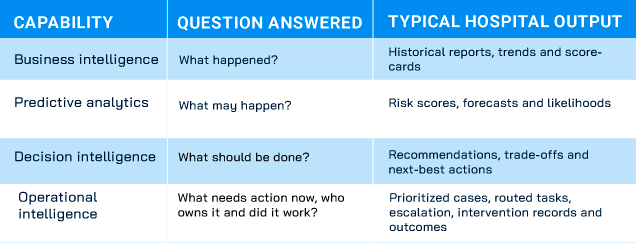
The practical unit of Hospital Operations Intelligence is an operational case. A case represents a risk, barrier or opportunity that requires action. It should include the triggering event, relevant evidence, priority, accountable owner, service-level deadline, recommended response, human decision, intervention history and measured result.
For example, a potential discharge delay might combine an unfinished consult, a pending payer approval, unavailable post-acute capacity and a transport constraint. None of those signals alone explains the complete barrier. An operational case assembles the context, assigns responsibility and tracks whether the barrier was removed in time to affect length of stay.
The same pattern applies to pre-bill denial risk. Encounter, authorization, clinical-documentation and claim information can be combined before submission. The system flags the exception, explains why it matters, routes the work to the correct team and records whether the claim was corrected and paid. A risk score alone does not protect revenue. Completed intervention and final disposition do.
A Hospital Operations Intelligence layer should sit above the EHR and adjacent systems, treating each source as authoritative for the information it owns. It should avoid copying every function into a new platform. Its role is to assemble context and coordinate work across boundaries.
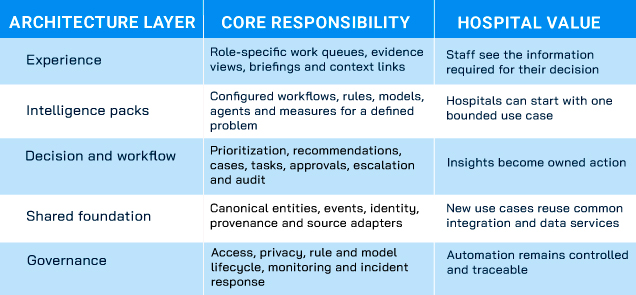
The architecture becomes useful when it is configured around a concrete executive outcome and an intervention that teams can perform. Priority applications include:
These use cases share the same operating logic: observe, interpret, coordinate and learn. They differ in source data, policy rules, owners, response times, safety controls and outcome measures.
Hospitals already depend on EHRs, ERP platforms, claims systems, clearinghouses, payer portals, workforce tools and analytics platforms. Replacing those systems creates cost and disruption without necessarily solving cross-functional coordination. A vendor-neutral intelligence layer can preserve existing investments while providing a common event model, workflow orchestration and benefits measurement across them.
Interoperability remains a design constraint, not a solved assumption. Interfaces can include FHIR, HL7, APIs, documents and scheduled extracts. The appropriate method depends on data availability, latency, quality, permitted write-back and the intervention window. Historical analysis may rely on batch data, while a same-day claim correction or patient-flow escalation may require near-real-time events.
Hospital Operations Intelligence represents a shift from digitizing individual functions to coordinating end-to-end outcomes. Its value does not come from adding another dashboard or producing more alerts. It comes from bringing the right evidence to the right owner while there is still time to act, then proving whether the intervention changed the result.
GCare.ai helps healthcare organizations deploy connected workflows, monitoring operations, risk visibility, and clinician-guided care coordination.
Why hospital leaders need an operating layer that connects real-time signals, accountable workflows and measurable outcomes
October 01, 2026