A practical approach to selecting the first workflow, governing AI, measuring value and scaling only after evidence
The greatest risk in Hospital Operations Intelligence is not that hospitals will lack algorithms. It is that they will add another technology layer without clarifying the workflow, authority, intervention window or value measure. A successful program begins with one bounded operational problem and an enterprise architecture that allows validated components to be reused later.
The principle is simple: start narrow, but design for scale. The first implementation should prove that the hospital can detect a meaningful risk, route it to an accountable person, support an approved intervention and measure the resulting outcome.
An attractive use case is not automatically a good pilot. The first workflow should combine material value with practical feasibility. It should have an intervention point that the hospital controls, a defined operating owner, accessible baseline data and outcomes that can be observed within a reasonable period.
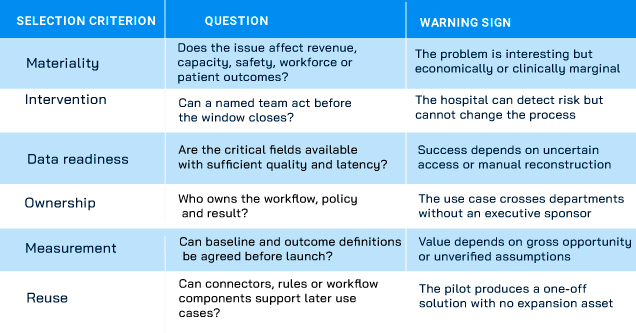
Pre-bill denial prevention is one strong financial wedge because the intervention occurs before submission, when the hospital may still correct an authorization, documentation or coding exception. Patient-flow and discharge-barrier management can be equally compelling where capacity is constrained. Post-discharge transition is suitable when the organization has accountable care, value-based contracts or a strategic need to reduce avoidable returns.
Discovery should map the current journey across people, policies and systems. For every critical exception, the team should define the start event, evidence, decision rule, owner, service-level deadline, escalation path, approval boundary and closure condition.
A complete operational case specification should answer:
This definition prevents a common failure: automating a weak or ambiguous process. Technology should not decide ownership or invent policy. It should make the agreed operating model executable and traceable.
Artificial intelligence can improve prioritization, summarize documents, assemble evidence and prepare a proposed action. It should not silently activate payer rules, alter a financial record, submit a claim or make a clinical decision. The level of automation should match the consequence of the action.
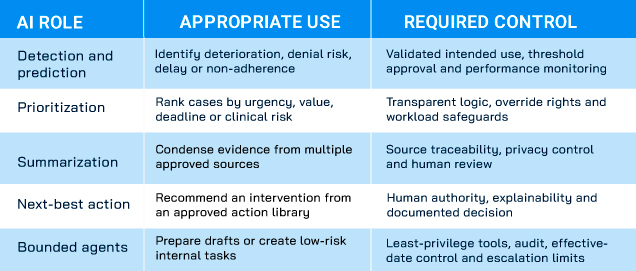
NIST's AI Risk Management Framework organizes AI risk activity around governance, mapping, measurement and management. In a hospital context, those functions should connect with clinical design authority, operational governance, data governance, security and benefits realization.[1] HHS guidance also requires appropriate administrative, physical and technical safeguards for electronic protected health information, with role-appropriate access and attention to the minimum necessary standard where applicable.[2,3]
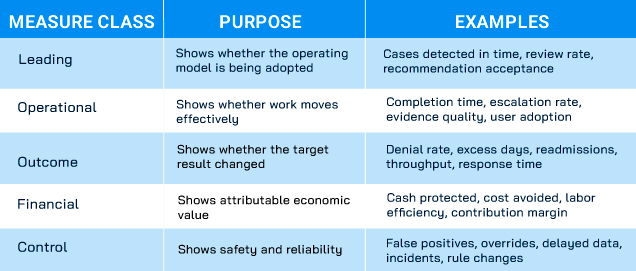
Operational Intelligence can produce impressive estimates of gross opportunity. Those estimates are not realized value. Hospitals need to follow the full intervention funnel and distinguish each stage:
This distinction is particularly important for revenue integrity. A prevented denial dollar is different from an identified risk dollar, and collected cash is different from a corrected claim. The same discipline applies to patient flow: a discharge barrier removed does not automatically equal monetized capacity. Finance and operations should agree the value calculation before the pilot begins.
Hospitals can reduce implementation risk through a staged approach that separates discovery, shadow validation and production intervention.
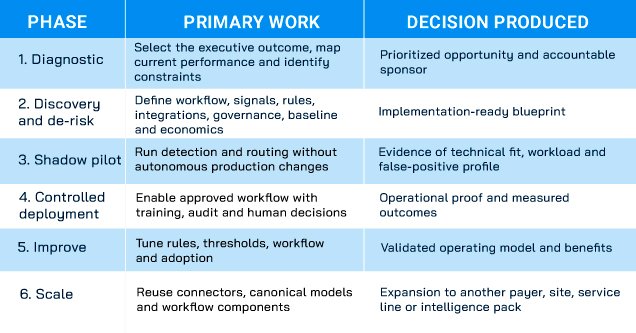
Shadow mode is especially valuable when trust and operational fit remain uncertain. It allows the hospital to evaluate what the system would have detected, how staff would have responded and whether the intervention window was realistic before enabling production action.
A narrow pilot should still contribute to an enterprise capability. Reusable assets may include source connectors, identity mapping, canonical encounter and case models, rule-management patterns, audit services, task-routing services, executive measures and governance controls.
Each subsequent use case will still require local configuration. Payer contracts, service levels, clinical pathways, escalation contacts and exception definitions cannot be treated as universal. The benefit of the shared layer is not zero configuration. It is lower incremental effort, consistent governance and a common way to connect intervention with outcome.
The right first decision is not whether to buy a broad AI platform. It is whether the hospital has one material operational problem where earlier detection, accountable resolution and defensible measurement can change the result.
If that problem exists, leadership should authorize a time-boxed discovery, define the human decision boundary, agree the baseline and test the workflow in shadow mode. Scale should follow evidence, not precede it.
GCare.ai is presented in these articles as a proposed Enterprise Care Operations Intelligence Layer. References to workflows, architecture and potential value describe a design and implementation approach. Outcomes should be established through hospital-specific discovery, baseline measurement and controlled validation rather than treated as guaranteed results.
GCare.ai helps healthcare organizations deploy connected workflows, monitoring operations, risk visibility, and clinician-guided care coordination.
A practical approach to selecting the first workflow, governing AI, measuring value and scaling only after evidence
October 01, 2026