Infrastructure, AI, and Operational Models for care between visits.
Healthcare organizations are facing growing pressure from rising chronic disease, workforce shortages, value-based care models, and increasing patient expectations. Yet most care delivery remains organized around episodic clinical encounters, leaving limited visibility into patient health between visits.
This gap has become one of the most significant challenges in modern healthcare. Most factors that influence outcomes - including medication adherence, symptom progression, recovery, and patient engagement - occur outside traditional care settings.
As healthcare shifts toward longitudinal, patient-centered care, organizations need new ways to identify risk, coordinate interventions, and support patients beyond the clinic. This has accelerated the emergence of Continuous Care Operations™ - an operational approach that combines patient monitoring, engagement, clinical workflows, and digital technologies to deliver proactive care between encounters.
At the center of this transformation is the Continuous Care Operating Model, a framework that converts patient signals into coordinated action through continuous monitoring, risk visibility, escalation coordination, clinician oversight, intervention, and continuous learning.
While healthcare organizations have invested heavily in digital technologies, technology alone does not create transformation. Sustainable Continuous Care requires operational integration across workflows, teams, governance structures, interoperability frameworks, and clinical processes. The challenge is no longer collecting data - it is turning data into timely, coordinated action.
This white paper examines the forces driving the need for Continuous Care Operations, the limitations of traditional episodic care, and the operational capabilities required to scale proactive care delivery. It introduces the Continuous Care Operating Model, explores the role of AI, interoperability, governance, and trust, and outlines how healthcare organizations are building the operational foundations for the next generation of care.
At Gcare.ai, we believe the challenge is no longer connecting patients to technology. The challenge is operationalizing care between visits.
Healthcare has made significant advances in clinical efficiency, care coordination, and digital recordkeeping. Yet most care delivery remains centered on episodic encounters, leaving limited visibility into patient health between visits.
This model was designed for acute conditions, but chronic diseases progress continuously, making episodic care increasingly inadequate.
Approximate share of the U.S. population living with at least one chronic condition.
Share of U.S. healthcare spending attributed to chronic diseases.
Share of European adults over 65 affected by chronic diseases.
The period between visits is a clinical blind spot where symptoms worsen, adherence declines, and preventable complications often go undetected.
Sources: NIH via PMC (2023); European Commission chronic disease statistics; Eurostat population projections.
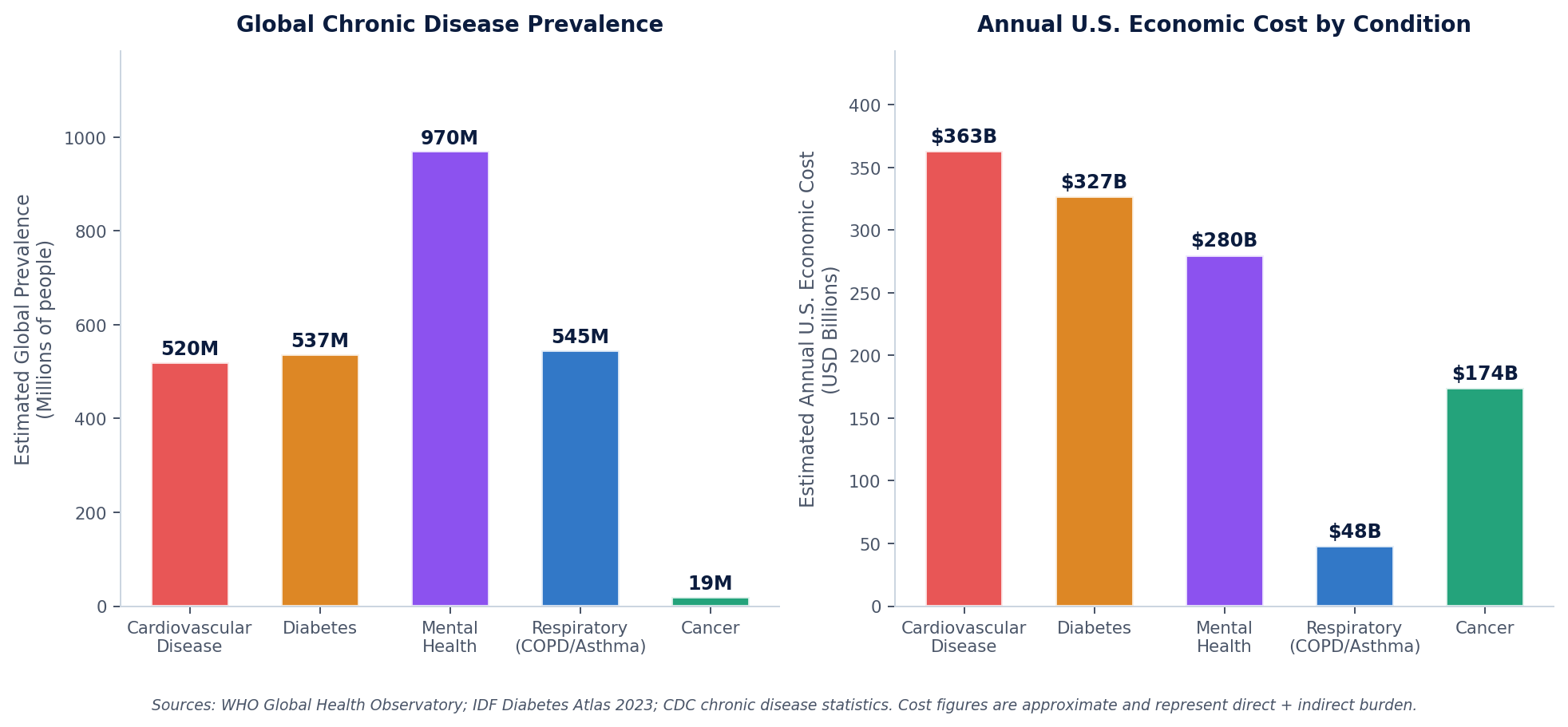
Figure 1: Global Chronic Disease Prevalence and U.S. Annual Economic Cost. Sources: WHO; IDF Diabetes Atlas 2023; CDC.
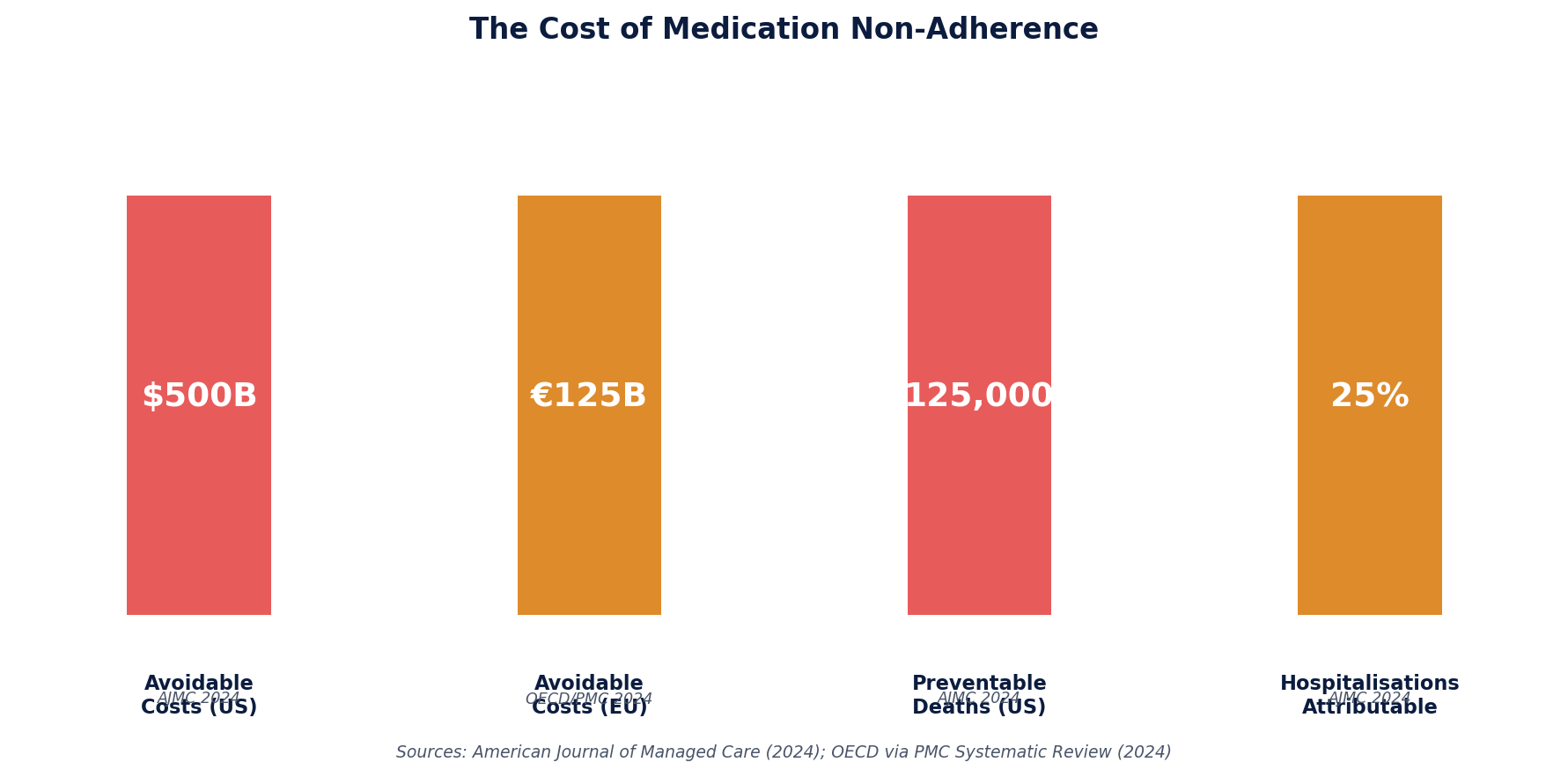
Figure 2: The Cost of Non-Adherence Medication. Annual impact across financial, mortality, and hospitalization dimensions.
The growing burden of chronic disease is accelerating the need for Continuous Care Operations. Non-communicable diseases are the leading drivers of healthcare spending, disability, and premature mortality worldwide.
Medication non-adherence further compounds the challenge. Nearly half of patients with chronic conditions do not take medications as prescribed, contributing to avoidable costs, preventable deaths, and unnecessary hospitalizations.
Most factors influencing outcomes occur outside traditional care settings, including medication adherence, lifestyle behaviors, symptom progression, recovery, disease self-management, and follow-up compliance.
Without visibility into these periods, healthcare organizations often miss opportunities for timely intervention, allowing preventable issues to escalate. This gap between visits has become a defining operational challenge in modern healthcare and a key driver of Continuous Care.
Healthcare is at an inflection point. The forces reshaping the industry are no longer temporary challenges - they are structural realities that require new models of care delivery.
Chronic conditions now account for most healthcare utilization and spending, requiring ongoing management rather than episodic intervention.
Provider, nursing, and care coordination shortages are increasing pressure on healthcare organizations to do more with limited resources.
As reimbursement shifts toward outcomes, organizations need greater visibility into patient health beyond traditional encounters.
Patients increasingly expect healthcare experiences that are connected, personalized, and accessible beyond clinics and hospitals.
Continuous Care is not an optional innovation initiative - it is rapidly becoming a strategic capability for improving outcomes, supporting care teams, and delivering scalable, patient-centered healthcare.
Purpose: Manage patients between visits.
Goal: Turn patient signals into coordinated action.
Outcome: Earlier intervention, improved engagement, and better outcomes.
The Continuous Care Operating Model provides a structured framework for managing patients between clinical encounters. It transforms fragmented patient signals into coordinated clinical actions, enabling healthcare organizations to deliver proactive, scalable, and outcome-driven care.
Rather than relying on episodic interactions, the model creates a continuous cycle of monitoring, risk assessment, intervention, and learning - ensuring that the right patients receive the right care at the right time.
Continuous Care Operations™: The Continuous Care Operating Layer connects patient signals, risk visibility, escalation coordination, clinician oversight, and intervention workflows.
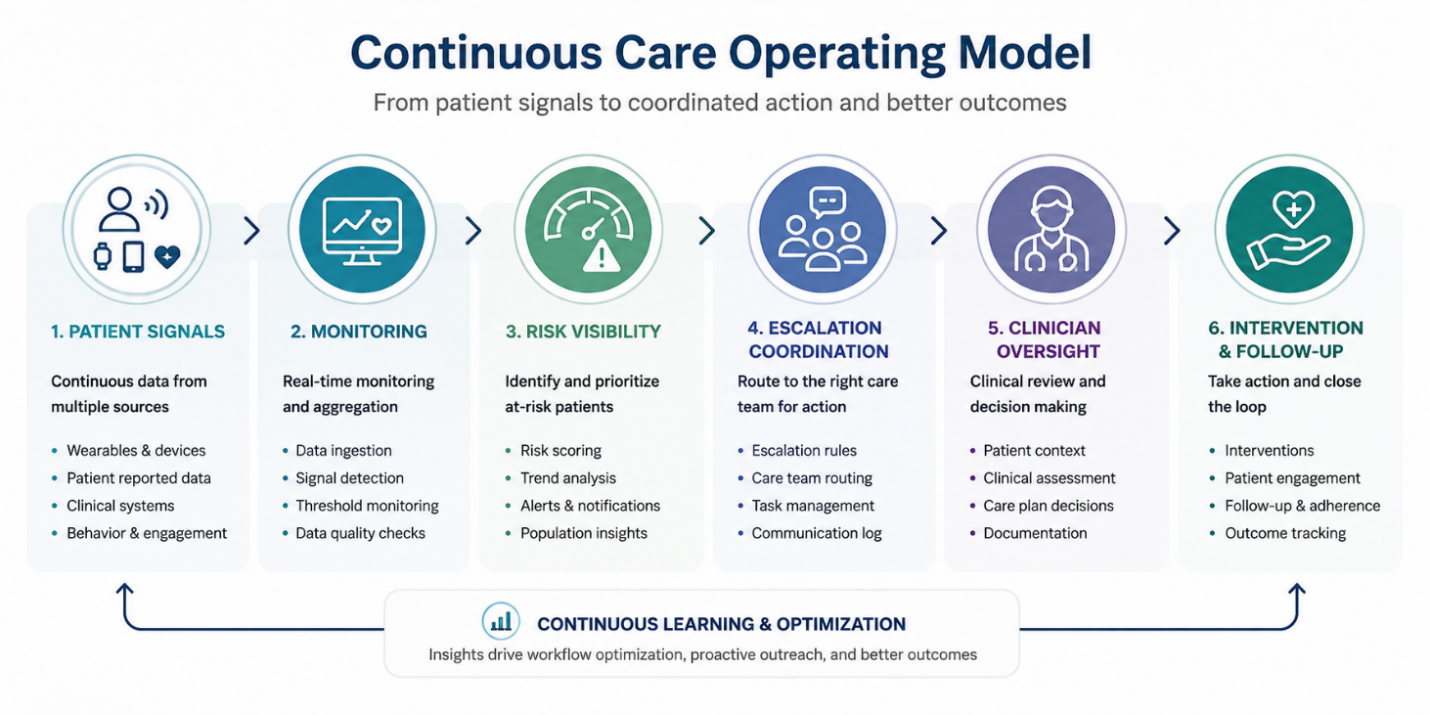
Continuous Care Operating Model: from patient signals to coordinated action and better outcomes.
Collect patient-generated and clinical data from devices, apps, surveys, EHRs, labs, and care interactions.
Outcome: A comprehensive and real-time view of patient status.
Monitor patient signals continuously or periodically to detect changes in health status, adherence, engagement, or recovery.
Outcome: Ongoing visibility into patient health between visits.
Analyze and prioritize collected data to identify patients who may require intervention.
Outcome: Actionable risk insights that focus attention where it is needed most.
Route identified risks through predefined workflows for timely review and intervention.
Outcome: Timely and consistent response to patient needs.
Enable care teams to review prioritized risks, apply clinical judgment, and determine appropriate interventions.
Outcome: Clinically informed decision-making with human oversight.
Deliver targeted outreach, care plan adjustments, referrals, education, and follow-up.
Outcome: Timely interventions that improve adherence, outcomes, and patient experience.
Measure operational and clinical outcomes to refine workflows, risk models, care pathways, and engagement strategies.
Outcome: A continuously improving care delivery system that scales effectively over time.
Continuous Care is an operating model that enables proactive patient management between visits. The goal is not to monitor every patient equally, but to identify the right patients at the right time and enable the right action before issues escalate.
Organizations struggle less with technology and more with operational execution. Barriers include fragmented tools, alert fatigue, manual triage, unclear escalation ownership, workflow burden, compliance complexity, and limited outcome measurement.
AI improves decision velocity, reduces operational burden, and makes patient signals more actionable. It creates value when it helps the right care team act on the right patient at the right time, with clinical oversight.
Leaders should evaluate Continuous Care investments as operating model decisions, not technology purchases. The strongest investments build on existing systems while creating a unified workflow layer across care delivery.
Leading health systems are moving beyond standalone digital tools toward continuous, technology-enabled care models. Key priorities include care-at-home, remote monitoring, AI-enabled workflows, virtual care, and longitudinal patient management.
Care-at-home programs combine virtual care, remote monitoring, in-home services, and centralized clinical oversight.
Implication: the home is becoming an extension of the care environment.
Remote monitoring is increasingly used for chronic disease management, risk prioritization, and care team efficiency - not just data collection.
Implication: value comes from converting data into prioritized clinical action.
Virtual care is being embedded into routine delivery to support access, transitions, monitoring, and continuity.
Implication: virtual care is becoming an integrated capability.
AI is being applied to improve workflows, reduce burden, prioritize patients, and accelerate decisions.
Implication: AI delivers value when embedded into operations.
Healthcare organizations have invested significantly in technologies designed to support longitudinal care delivery, including EHRs, remote monitoring, remote therapeutic monitoring, virtual care, patient engagement, digital therapeutics, care management, population health, and AI-enabled applications.
These investments have created unprecedented access to patient data and engagement channels. However, many organizations continue to struggle with adoption, workflow integration, clinical utilization, and operational scale.
Healthcare organizations have invested heavily in digital health technologies, yet many continue to struggle with care coordination, patient engagement, workforce capacity, and longitudinal care.
The challenge is not a lack of technology - it is a lack of operational integration. Technology can enable Continuous Care Operations, but it only delivers value when embedded into clinical workflows, care team operations, governance frameworks, and decision-making processes.
More data can create more noise. Effective Continuous Care requires risk stratification and escalation workflows that help clinicians focus on the patients who need attention most.
Care teams often navigate multiple systems to coordinate care. The challenge is no longer deploying systems - it is orchestrating workflows across them.
Scaling requires clear ownership, escalation protocols, clinical accountability, operational oversight, and outcome measurement.
Technology adoption accelerates when tools fit existing workflows, reduce burden, support decisions, and improve efficiency without increasing complexity.
Manual monitoring, outreach, and follow-up become unsustainable as patient volumes grow. Teams need automation, prioritization, and decision velocity.
Enrollment, messages, interactions, and alerts show activity - not impact. Scalable programs define outcome measurement from the start.
Technology alone does not drive transformation - operational integration does.
Healthcare organizations are shifting from asking how advanced AI is to how effectively it improves care delivery. The most successful AI initiatives focus on workflow transformation - not technology deployment.
Identifying patients who need immediate attention.
Improving engagement, adherence, and care continuity.
Delivering actionable insights at the point of care.
Connecting patients, teams, and workflows.
Reducing administrative effort and improving efficiency.
The future of healthcare AI is not standalone algorithms. It is AI embedded into everyday care workflows - improving prioritization, accelerating interventions, and enabling Continuous Care Operations at scale.
Healthcare organizations have invested heavily in EHRs, RPM, patient engagement, virtual care, and analytics platforms. Yet care gaps persist because technology alone does not connect patient signals to clinical action.
Provides data, not action.
Creates communication, not coordination.
Document care but are not designed to manage continuous care workflows.
Effective Continuous Care Operations require three capabilities: risk visibility, escalation coordination, and clinician oversight. Together, these capabilities transform patient data into timely interventions.
Trust is essential for scaling Continuous Care Operations. Patients, clinicians, care teams, and leaders must trust how decisions are made, risks are managed, and outcomes are measured.
Clear accountability, escalation protocols, and oversight.
Explainable decisions and visible care processes.
Human judgment remains central to care delivery.
AI supports decisions through explainability, governance, and human review.
Demonstrating measurable clinical and operational value.
Healthcare organizations scale what they trust.
Continuous Care Operations depend on connecting patient signals, clinical systems, and care workflows across the healthcare ecosystem. Without interoperability, information remains fragmented, limiting visibility and delaying intervention.
FHIR has emerged as the industry standard for healthcare data exchange, enabling information to move more effectively across EHRs, monitoring platforms, and care systems.
The 2024 State of FHIR Survey found FHIR R4 is the primary version in use across 22 of 38 surveyed healthcare organizations. In the U.S., ONC's HTI-1 Final Rule requires FHIR APIs by January 2025, and CMS's Prior Authorization Rule mandates FHIR for payer processes by January 2026.
Source: 2024 State of FHIR Survey; ONC HTI-1 Final Rule; CMS Prior Authorisation Rule; National Academy of Medicine (2026).
Legacy systems, proprietary platforms, and diverse data sources require alignment across data models, workflows, security, and operations.
Reliable, timely, and actionable information is required to support accurate risk identification and intervention.
The true value of interoperability lies in turning data into coordinated action.
The Continuous Care Operating Model is applicable across a wide range of healthcare programs. While use cases vary, the underlying operational requirements remain remarkably similar.
Healthcare is shifting from episodic care to continuous, proactive care models. As chronic disease, workforce shortages, rising costs, and value-based care pressures grow, organizations need better ways to manage patients between visits.
Healthcare is shifting from episodic care to continuous, patient-centered care. As chronic disease, workforce shortages, value-based care, and rising patient expectations reshape the industry, Continuous Care Operations are becoming a core healthcare capability.
Future healthcare leaders will differentiate themselves by their ability to maintain visibility between visits, coordinate timely interventions, deliver personalized engagement at scale, improve care team productivity, and measure outcomes continuously.
AI will increasingly operate as embedded infrastructure, enhancing prioritization, coordination, and decision-making rather than functioning as a standalone technology.
Continuous Care Operations are evolving from a digital health initiative into the operational foundation of modern healthcare.
Continuous Care Operations are becoming the operational foundation of modern healthcare. Organizations that can continuously identify risk, coordinate action, and measure outcomes between visits will be best positioned to improve patient outcomes, support clinicians, and thrive in the next era of healthcare delivery.
Gcare.ai was created to help healthcare organizations operationalize Continuous Care at scale - connecting patient signals, workflows, clinical oversight, and outcomes into a unified operating model.